What is CHANGE?

Why is this project needed?
- To ensure a society where the best possible care is always available -
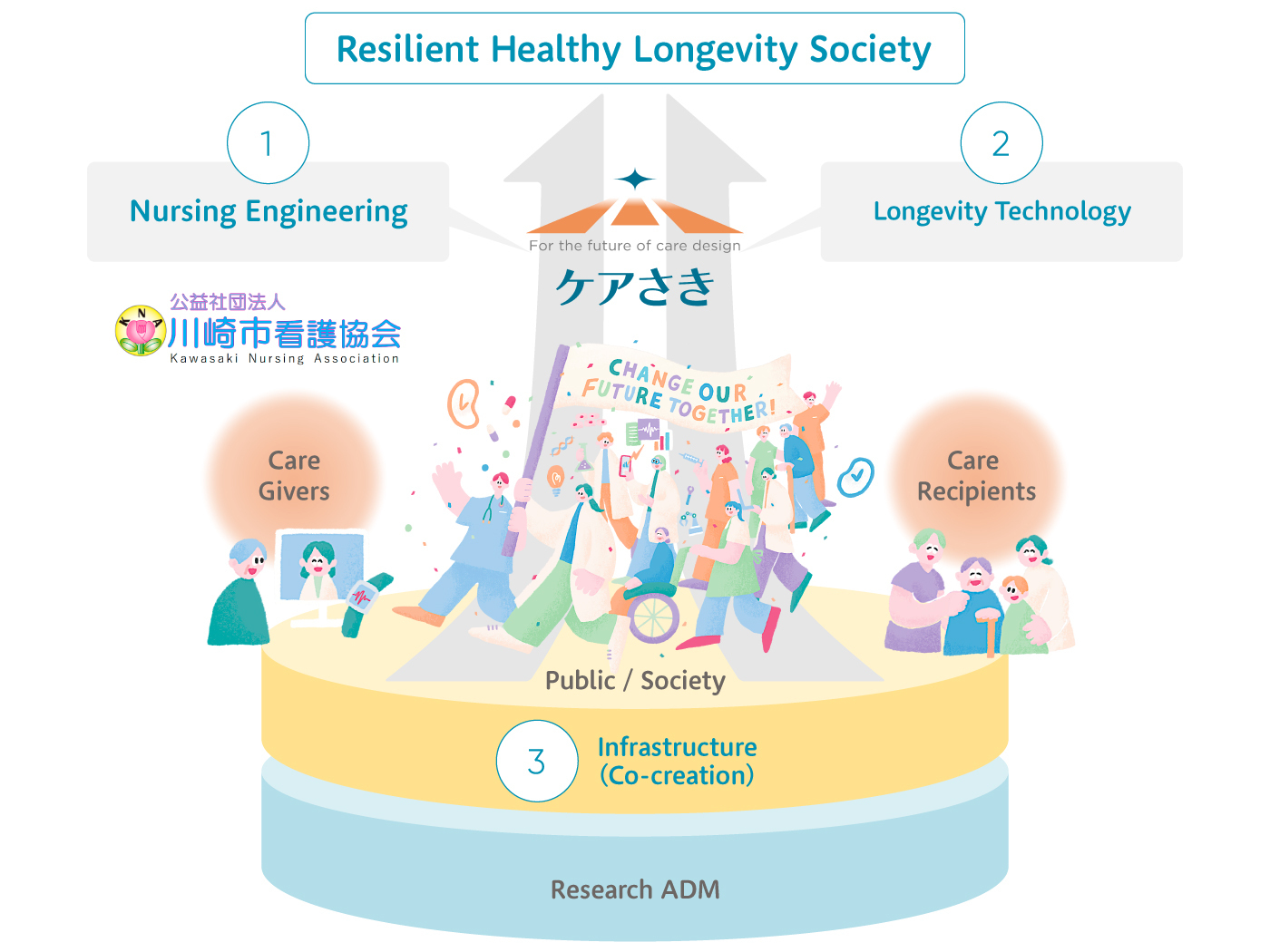
Japan is experiencing an unprecedented rate of population aging and declining birth rates. The healthcare and nursing sectors face persistent severe labor shortages, making the establishment of a sustainable care system a major societal challenge. Against this backdrop, the Ministry of Education, Culture, Sports, Science and Technology (MEXT) and Japan Science and Technology Agency (JST) launched the COI-NEXT Kawasaki Hub (Project CHANGE) with the vision of “Building a Resilient Healthy Longevity Society Led by Medical-Engineering-Nursing Co-creation.” This hub is unique among selected sites in being led by a municipal organization, the Kawasaki Institute of Industrial Promotion (KIIP), fostering a practice-oriented environment and culture distinct from university-led hubs. The Innovation Center of NanoMedicine, the research arm of the KIIP, is an international research hub with over 40% of its researchers being foreign nationals. Its Innovation Promotion Team, tasked with transforming this diversity into a driving force, also functions as the research administration body for the entire Project CHANGE. Furthermore, Kawasaki City is home to Japan's only city-level nursing association (Kawasaki Nursing Association). This association is a crucial partner in the project's core “Nursing × Engineering” initiative, enabling the aggregation of real-world nursing needs and the rapid evaluation and feedback of prototypes. Additionally, to swiftly connect research outcomes to societal implementation, the Kawasaki Care Design Consortium (Care-Saki) was established. It provides comprehensive support, from proof-of-concept studies to commercialization, for products aimed at reducing labor burdens in nursing and care settings. The term “Resilient,” a key goal of the hub, signifies a state of being “flexible and capable of recovery.” The engineering field includes a research area called Resilience Engineering, which focuses on reducing vulnerability to unforeseen events. We are applying this concept to healthcare and care. Illness is, in a sense, a “disaster.” It is crucial to establish a “disaster prevention system” in peacetime that enables people to return to society as early as possible. We have set the following three targets, aiming to realize a society where even elderly individuals who fall ill can regain independent living and achieve healthy longevity.
-
1
Creating an environment where care providers can be close to patients (Nursing Engineering)
― Innovation for those providing care
-
2
Delaying age-related physical decline (Longevity Technology)
― Innovation for those receiving care
-
3
Building social infrastructure to accelerate healthy longevity innovation
― Innovation supporting society as a whole
Vision of Project CHANGE
"CHANGE" is an Industry-Academia-Government co-creation program and one of "COI-NEXT" projects

The Program on Open Innovation Platforms for Industry-Academia Co-Creation (COI-NEXT) is an industry-academia collaborative program in which universities and other institutions take the lead in formulating a vision for future society and promoting research and development to realize this vision, while aiming to form self-sustaining centers. Launched in FY2020, the program is designed based on the “vision-driven, backcasting-type of R&D” of the Center of Innovation (COI) program. As the role of universities in creating innovation is growing in importance, it is necessary to solve current and future issues with new knowledge and collaboration with stakeholders. To this end, it is essential to build an innovation ecosystem through industry-academia-government co-creation with the government's priority support. In this program, a vision for a future society based on the SDGs will be established as the center's vision, involving a variety of stakeholders, including universities, industry, local governments, and citizens. Toward the realization of this vision, the program will promote research and development through a backcasting approach and the establishment of a sustainable industry-academia-government co-creation system in an integrated manner. Through this initiative, we will promote the formation of hubs by leveraging the strengths of universities and other institutions, contributing to national growth and regional development, while promoting the transformation into a knowledge-intensive society.
Origine of the name "CHANGE"

As the Chinese characters indicate, nursing is about caring with hands and eyes. However, in a super-aging society where the number of patients is increasing and the number of medical professionals is decreasing, unless more human hands are supplemented by technologies and/or engineering systems, the burden on care workers will increase, leading to exhaustion in the field. The logo above is inspired by COI-NEXT's catchphrase, “Change,” and adds a playful twist with “CHANGE” when the “T” is layered over the “C” in “CHANCE,” as well as the “CHANCE” of apricot orange, floating like the morning sun, from “Blue Ocean,” which symbolizes an undeveloped market. We see the present time as a CHANCE (opportunity) and will strive to change society through our superior Technology and Talent, as well as Tolerability and Thoughtfulness.